History of Parsley – Proverbs & Folklore
(Carum Petroselinum, Linn.)
Before we begin talking about parsley history, I think I need to clarify something. Much of the folklore surrounding parsley can be probably attributed to a look-alike plant called fool’s parsley that is actually deadly. I’ve tried to rely only on those sources that made it clear they were discussing carum petroselinum and not fool’s parsley.
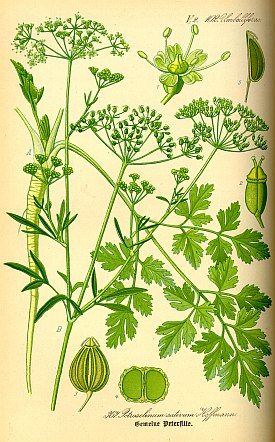
Greek gardens often had borders of parsley and rue which led to the saying “Oh! we are only at the Parsley and Rue” to signify when an undertaking was in contemplation and not fully acted upon.
The Romans did not generally eat parsley either but they did wear garlands of parsley on their heads during feasts to ward off intoxication. Parsley was kept away from nursing mothers because it was thought to cause epilepsy in their babies.
In researching parsley history, I found some folklore that seeks to explain why parsley seeds have fairly low germination rates. It was said that the reason for the slow and unreliable germination of parsley is that the seed goes nine times to the Devil and back before coming up. The ungerminated seeds are the ones that the Devil keeps for himself. In some areas, the belief went even further claiming that only if the woman was master of the household would parsley start to grow.
Ironically, at Roman weddings, wreaths of parsley were given to protect against evil spirits. Perhaps, any parsley that had actually grown was considered unacceptable to the devil and was therefore not attractive to evil spirits?
Parsley History: English Folklore
Apparently it wasn’t just the Ancients who attached odd folklore to parsley; the people in old England had their own set of parables and folklore surrounding the plant. Different regions of England also had their own versions of parsley history and folklore.
Parsley was also associated with death in England. A common saying was ‘Welsh parsley is a good physic’ – ‘Welsh parsley’ signified the gallows rope. In Surrey and in other southern English counties it was said, “Where parsley’s grown in the garden, there’ll be a death before the year’s out.”
While certainly not as dramatic as a death sentence, it was believed if someone cut parsley that they would be later crossed in love.
Transplanting parsley would appear to be an equally unfavorable activity. In Devonshire, it was believed that anyone who transplanted parsley would offend the ‘guardian genius’ who presides over parsley beds. The evil transplanter or a member of his family was thought to be punished within a year. (No specifics were given as to what sort of punishment could be expected.) And, in Hampshire, peasants feared giving away any parsley as it would bring ill-luck upon them.
One woman in Morwenstow claimed that one of her children sickened after an “unfortunate undoing of the parsley bed.”
In Suffolk, it was thought sowing Parsley seed on Good Friday would ensure the herb coming up “double”.
Parsley History: Early Medicinal Uses
Pliny (23 – 79 AD) mentioned parsley as a cure for ailing fish and listed it as a popular flavoring for broths and sauces. He also made mention of a curled variety. In Tudor times through to recent years, parsley was thought to be a remedy for baldness.
Parsley history includes its use as an antidote against poisons. One of our sources suggested that parsley’s ability to counteract the strong smell of garlic as a possible source for this belief and usage.
Charlemagne was said to have favored cheese flavored with parsley seeds.Gerard, author of Herball or Historie of Plants(1597), grew both the smooth and curled leaf varieties and described the curled variety as “fannes of curled feathers.”
Nicholas Culpepper (1616 – 1654), a physician-astrologer, said “it brings urine and women’s curses”, referring to parsley’s diuretic effect and the belief it could both bring on and relieve the discomforts associated with a woman’s monthly cycle.
Tournefort (1656 – 1708), despite being perhaps the greatest European botanist of his century, believed parsley to contain an acrid and corrosive salt. That salt, when wet with water and left in contact with a glass, would cause the glass to become extremely fragile and easily be broken.
The Gardener’s Dictionary, published in 1805 by Phillip Miller, identified parsley as being fatal to small birds. It goes on to say that parsley can injure the sight and aggravate or even cause epilepsy.
Parsley history includes a bit of veterinary medicine. Farmers once thought that parsley prevented a number of diseases in sheep and would plant fields of it to keep their flock healthy. Parsley, with it’s strong aroma, would unfortunately attract an overabundance of rabbits and hares which would come from long distances to eat the parsley leaving many farmers to fence in their fields of parsley.
Seeing the dilemma of the farmers, gardeners planted carnations with their parsley in hopes of providing the rabbits and hares an alternative. Unfortunately, the parsley was still eaten and the carnations were simply trampled.
Additional Parsley Information.
Thankfully, in spite of its connections with death and suffering, along the way, someone figured out that parsley was quite tasty and worthy of growing. Along with this historical look at the origins and early uses of parsley, Our Herb Garden has guides on Growing Parsley and Parsley Companion Planting.
Thank you for sharing. Ive just made a batch of parsley tea but love reading about the history of the herbs
You’re most welcome! These history articles are fun to write. One thing they’ve all made clear, people’s diets back in the day were not particularly gut friendly if one can infer that from the amount of attention paid to poisoning, upset stomach and flatulence cures.
Hi! I loved this post! It was very useful during my research, thank you!
You are most welcome. Whether you are doing research for work or school, please remember to cite your sources; too many folks don’t.